
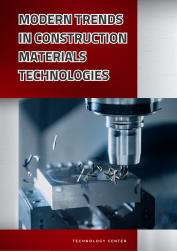
MODERN TRENDS IN CONSTRUCTION MATERIALS TECHNOLOGIES
Keywords:
Chromium-manganese alloys, chemical composition, phase composition, thermal analysis, crystallization, wear resistance, heat treatment, structure, alloying, operational durability, inclusive engineering, craft technologies, design, architectural solutions, building materials, sustainable development, ost-war reconstruction of Ukraine, food service facilities, quality, safety, HACCP, high-entropy alloys, heat resistance, elastic properties, thermophysical parameters, B2-phase, fluidity, induction melting, reinforced cast structure, reinforcing filler, matrix melt, gas-hydrodynamic conditions, heat exchange processes, computer simulation, polystyrene foam pattern, cast steel, lost foam casting, heat treatment of steel, technological processSynopsis
The monograph is devoted to the actual scientific and practical problems of materials science, foundry production and engineering and architectural solutions, which are of great importance for the industrial development and post-war reconstruction of Ukraine. The book comprehensively combines research in the field of creation of new metal materials with increased operational properties and development of inclusive and sustainable engineering approaches in construction and environmental design.
The first chapter substantiates the rational compositions of chromium-manganese alloys and investigates the regularities of formation of their structure, phase composition and properties in the cast state. The possibilities of reducing the energy intensity of casting processes and increasing the wear resistance of products compared to traditional alloys-analogues are shown. The prospects of using the developed materials to increase the operational stability of piercing mandrels of pipe rolling mills are determined, provided that the heat treatment regimens are optimized and metastable self-strengthening structures are formed.
The second chapter is devoted to the integration of the principles of inclusive engineering and artisanal technologies in the design of public catering establishments in the conditions of post-war reconstruction of Ukraine. The choice of environmentally friendly building materials and architectural solutions that ensure accessibility, safety, energy efficiency and compliance with sanitary and hygienic requirements (HACCP) is justified. The proposed approach contributes to the sustainable development of communities, reducing the environmental load and preserving local cultural identity.
The third chapter considers promising high-entropy alloys based on the FeNiCrCuAl and FeNiCrCuMn systems as heat-resistant casting materials of a new generation. Based on thermodynamic calculations, structural-phase analysis and research of thermophysical, mechanical and casting properties, their high structural stability and feasibility of use in conditions of elevated temperatures are confirmed.
The fourth chapter highlights the scientific and technological prerequisites for obtaining steel hollow castings with composite and reinforced non-metallic fillers by the casting method using gasified models. A mathematical description of gas-hydrodynamic processes has been developed, computer modeling and experimental verification of technological solutions that are important for the manufacture of special and protective casting products have been carried out.
The book is addressed to scientists, practicing engineers, foundry specialists, architects and designers, as well as scientific and pedagogical workers and higher education students in the specialties of materials science, metallurgy and civil engineering.
Chapters
References
Glazov, V. M., Timoshina, G. G., Mikhailova, M. S. (1996). Printcipy legirovaniia kremniia dlia povysheniia ego termostabilnosti. Doklady Akademii Nauk, 347 (3), 352–355.
Taran, Yu. N., Glazov, V. M., Regel, A. R., Kutsova, V. Z., Koltsov, V. B., Timoshina, G. G. et al. (1991). Strukturnye prevrashcheniia pri nagreve monokristallov kremniia Fizika i tekhnika poluprovodnikov, 4 (25), 588–595.
Kol’tsov, V. B., Zubkov, A. M., Timoshina, M. I. (2002). Metodika issledovaniy elektrofizicheskikh svoystv monokristallov kremniya v shirokom intervale temperatur. Fizika poluprovodnikov i polumetallov. Saint-Petersburg.
Kozhitov, L. V., Botavin, V. V., Shepel, P. N., Timoshina, G. G., Timoshina, M. I. (2002). Issledovanie kinetiki raspada kremniia, legirovannogo perekhodnymi i redkozemelnymi elementami. Kremniy-2002. Novosibirsk, 129.
Novokhatskiy, I. A., Kisun’ko, V. Z., Ladyanov, V. I. (1985). Osobennosti proiavlenii razlichnykh tipov strukturnykh prevrashchenii v metallicheskikh rasplavakh. Izvestiya vuzov. Chernaya metallurgiya, 5, 1–9.
Kutsova, V. Z., Nosko, O. A., Timoshina, M. I. (2006). Alloying effect on structure and properties of semiconductor silicon. Proceeding of the International Conference Silicon 2006, 450–459.
Tonkov, E. Yu. (1988). Fazovye prevrashcheniia soedinenii pri vysokom davlenii. Vol. 1, 2. Moscow: Metallurgiya, 463, 356.
Kutsova, V. Z., Nosko, O. A., Timoshina, M. I. (2007). Vliianie legiruiushchikh elementov na strukturu, fazovyi sostav i svoistva poluprovodnikovogo kremniia. Kremniy-2007. Moscow: Gosudarstvennyy tekhnologicheskiy universitet “Moskovskiy institut stali i splavov”, 109.
Glazov, V. M., Zemskov, B. S. (1967). Fiziko-khimicheskie osnovy legirovaniia poluprovodnikov. Moscow: Nauka, 372.
Klevan, O. S., Engh, T. A. (1995). Dissolved impurities and inclusions in FeSi and Si, development of a filter sampler. INFACON 7. Trondheim, 441–451.
Prikhodko, E. V. (1983). Metallokhimiia kompleksnogo legirovaniia. Moscow: Metallurgiya, 184.
Nesterenko, A. M., Uzlov, K. I., Kutsova, V. Z., Nyshchenko, A. N. (1988). Vliianie skorosti okhlazhdeniia na obrazovanie tverdykh rastvorov v sisteme Al-Si. Izvestiya AN SSSR, Metally, 2, 192.
Savitskiy, E. M., Burkhanov, S. S. (1967). Metallovedenie tugoplavkikh metallov i splavov. Moscow: Nauka, 324.
Liubov, B. Ia. (1969). Kineticheskaia teoriia fazovykh prevrashchenii. Moscow: Metallurgiia, 264.
Taran, Yu. N., Kutsova, V. Z., Uzlov, K. I., Falkevich, E. S. (1992). Shearing phase transformations in semiconductors. Proceeding of the International Conference ‘Silicon 92’, 88–95.
Milvidskiy, M. G., Osvenskiy, V. B. (1984). Strukturnye defekty v monokristallakh poluprovodnikov. Moscow: Metallurgiya, 256.
Glazov, V. M., Koltsov, V. B., Kutsova, V. Z., Taran, Yu. N., Timoshina, G. G., Uzlov, K. I., Falkevich, E. S. (1990). Issledovanie elektro-fizicheskikh svoystv kremniya v shirokom intervale temperatur. Elektronnaya tekhnika, 11.
Glazov, V. M., Kurbatov, V. A., Koltsov, V. B. (1985). Issledovanie effekta Kholla antimonidov Ga i In v tverdom i zhidkom sostoyanii. Fizika i tekhnika poluprovodnikov, 19 (4), 662–667.
Kopaev, Iu. V., Meniailenko, V. V., Molotkov, S. N. (1985). Neravnovesnye fazovye perekhody v kovalentnykh poluprovodnikakh pod vozdeistviem lazernogo izlucheniia. Fizika tverdogo tela, 27 (11), 3288–3294.
Landau, L. D., Lifshits, E. M. (1964). Statisticheskaia fizika. Moscow: Nauka, 568.
Tairov, Yu. M., Tsvetkov, V. F. (1980). Rost kristallov i politipizm karbida kremniya. Rost kristallov, 13, 104–111.
Taran, Yu. N., Kutsova, V. Z., Chervonyy, I. F., Shvets, E. Ya., Falkevich, E. S. (2004). Poluprovodnikovyy kremniy: teoriya i tekhnologiya proizvodstva. Zaporozhe: Zaporozhskaya gosudarstvennaya inzhenernaya akademiya, 344.
Alshits, V. I., Darinskaya, E. V., Koldaeva, M. V., Petrzhik, E. A.; Hirth, J. P. (Ed.) (2008). Magnetoplastic Effect in Nonmagnetic Crystals. Dislocations in solids. Amsterdam: Elsevier, 14 (86), 333–437. https://doi.org/10.1016/s1572-4859(07)00006-x
Alshits, V. I., Darinskaya, E. V., Koldaeva, M. V., Petrzhik, E. A. (2003). Magnetoplastic effect: Basic properties and physical mechanisms. Crystallography Reports, 48 (5), 768–795. https://doi.org/10.1134/1.1612598
Golovin, Yu. I. (2004). Magnitoplastichnost tverdykh tel (Obzor). Fizika Tverdogo Tela, 46, 769.
Morgunov, R. B. (2004). Spinovaia mikromekhanika v fizike plastichnosti. Uspekhi fizicheskikh nauk, 174, 131–153.
Buchachenko, A. L. (2013). Mass-Independent Isotope Effects. The Journal of Physical Chemistry B, 117 (8), 2231–2238. https://doi.org/10.1021/jp308727w
Zinenko, V. N., Sorokin, B. P., Turchin, P. P. (1983). Osnovy fiziki tverdogo tela. Moscow: Vysshaia shkola, 330.
Milnes, A. G., Feuch, D. L. (1972). Heterojunctions and Metall-Semiconductor Junctions. New York; London: Academic Press, 418. https://doi.org/10.1016/b978-0-12-498050-1.x5001-6
Zhitinskaya, M. K., Nemov, S. A., Svechnikova, T. E. (1997). Vliyanie neodnorodnostey kristallov Bi2Te3 na poperechnyy effekt Nernsta – Ettingsgauzena. Fizika i tekhnika poluprovodnikov, 31 (4), 441–443.
Chervonyi, I. F., Kutsova, V. Z., Pozhuiev, V. I., Shvets, Ye. Ya., Nosko, O. A., Yehorov, S. H., Voliar, R. M. (2009). Napіvprovіdnikovyi kremnіi: teorіia і tekhnolohіia vyrobnytstva. Zaporіzhzhia, 350.
Vapnik, V. N. (Ed.) (1984). Algoritmy i programma vosstanovleniya zavisimostey. Moscow: Nauka, 816.
Kutsova, V. Z., Nosko, O. A., Tutyk, V. A., Sulay, A. M. (2015). Struktura, mekhanichni ta elektrofizychni vlastyvosti monokrystalichnoho kremniiu pid diieiu postiinoho mahnitnoho polia. Metallurgicheskaya i gornorudnaya promyshlennost, 1, 73–79.
Kutsova, V. Z., Nosko, O. A., Sulay, A. M. (2014). Vliianie legirovaniia i termicheskoi obrabotki na strukturu i svoistva poluprovodnikovogo kremniia. Metallurgicheskaya i gornorudnaya promyshlennost, 6, 65–72.
Kutsova, V. Z., Nosko, O. A., Sulay, A. M. (2015). The structure, mechanical and electrophysical properties of monocrystalline silicon under influence of constant magnetic field. Ukrainian journal of mechanical engineering and materials science, 1 (1), 91–98.
Kutsova, V. Z., Nosko, O. A., Sulai, A. M. (2017). The influence of constant magnetic field on the structure and properties of monocrystalline silicon. Metaloznavstvo ta termichna obrobka metaliv, 2, 32–40.
Bonch-Bruevich, V. P., Kalashnikov, S. G. (1990). Fizika poluprovodnikov. Moscow: Nauka, 685.
Moss, T. S., Burrell, G. J., Ellis, B. (1973). Semiconductor opto-electronics. Butterworth-Heinemann, 441. https://doi.org/10.1016/c2013-0-04197-7
Kutsova, V. Z., Uzlov, K. Y., Khronenko, V. M. (1999). Temperaturnaya zavisimost’ otnositel’nogo udlineniya sverkhchistogo kremniya. Metallurgicheskaya i gornorudnaya promyshlennost, 4, 72–74.
Taran, Iu. N., Kutcova, V. Z., Kovalchuk, M. G., Uzlov, K. I. (1988). Neodnorodnost beta-tverdogo rastvora v siluminakh. Metallovedenie i termicheskaia obrabotka metallov, 9, 33–37
Taran, Yu. N., Kutsova, V. Z. (2002). Fazovye prevrashcheniya i svoystva poluprovodnikovogo kremniya. Vysokochistye metallicheskie i poluprovodnikovye materialy. Kharkovskaya nauchnaya assambleya ISPM-8, 68–73.
Taran, Yu. M., Kutsova, V. Z., Nosko, O. A. (2002). Fazovi peretvorennia ta vlastyvosti napivprovidnykovoho kremniiu. Metaloznavstvo ta obrobka metalіv, 1–2, 59–65.
Taran, Yu. M., Kutsova, V. Z., Nosko, O. A. (2004). Semiconductor–Metal Phase Transitions. Uspehi Fiziki Metallov, 5 (1), 87–166. https://doi.org/10.15407/ufm.05.01.087
Kutsova, V. Z., Stetsenko, A. P., Mazochuk, V. F. (2017). Phase transformations in semiconductor silicon by the influence of magnetic field. Systemni tekhnolohii. Rehionalnyi mizhvuzivskyi zbirnyk naukovykh prats, 5 (112), 103–107.
Oranska, O. I., Gornikov, Yu. I., Gun’ko, V. M., Brichka, A. V. (2022). On the use of model diffraction profiles in the microstructure analysis of nanocrystalline metal oxides based on powder x-ray diffraction data. SURFACE, 14 (29), 148–158. https://doi.org/10.15407/surface.2022.14.148
Makara, V. A., Vasiliev, M. O., Steblenko, L. P., Koplak, O. V., Kuryliuk, A. M., Kobzar, Yu. L., Naumenko, S. M. (2009). Influence of Magnetic Treatment on the Microhardness and Surface Layers Structure of Silicon Crystals. Physics and Chemistry of Solid State, 10 (1), 193–198.
Nosko, O. A. (2006). Osobennosti struktury, fazovye prevrashcheniya legirovannogo kremniya i modifitsirovannykh zaevtekticheskikh siluminov i razrabotka sposobov povysheniya ikh svoystv [PhD dissertation]. Dnepropetrovsk, Ukraine.
Kutsova, V. Z. (1993). Teoriya i praktika upravleniya strukturoy i svoystvami liteynykh splavov na osnove alyuminiya i titana [Doctor's thesis]. Dnepropetrovsk, Ukraine.
Kuzmin, A., & Krymskaya, N. (2023). Public Space during the War. In Re:imagine your city – rethinking urban paradigms (pp. 68–71). Berlin, Germany: SHIFT BOOKS / Umweltdruck.
Ivanova, H. P., Olishevska, V. Y., Hapieiev, S. M., & Olishevska, S. O. (2024). Construction industry in Ukraine: transformations and prospects in the context of martial law and post-war reconstruction. Science and Transport Progress, 4(108), 80–88. https://doi.org/10.15802/stp2024/317405
Kucher, A., Kucher, L., Rudenko, D., & Synytsia, O. (2024). Development of «green» building in the context of «green» post-war recovery. Journal of Innovations and Sustainability, 8(2), 10. https://doi.org/10.51599/is.2024.08.02.10
Bielohrad, A. (2024). Assessment of the opportunities of demolition waste using as a building material of the future in Ukraine. Technology Audit and Production Reserves, 3(3(77)), 25–29. https://doi.org/10.15587/2706-5448.2024.307317
Kuzmin, O., Levkun, K., & Riznyk, A. (2017). Qualimetric assessment of diets. Ukrainian Food Journal, 6(1), 46–60. https://doi.org/10.24263/2304-974X-2017-6-1-7
Koretska, I., Kuzmin, O., Polyovyk, V., Deinychenko, L., Berezova, G., & Stukalska, N. (2021). Quality rating of desserts based on fruit and berry raw materials. Ukrainian Journal of Food Science, 9(1), 71–87. https://doi.org/10.24263/2310-1008-2021-9-1-8
Shevchenko, O. Y., Kuzmin, O. V., Dudarev, I. M., Melnyk, N. A., Murzin, A. V., Ushchapovskyi, A. O., Chemakina, O. V., Kuzmin, A. O., & Kuzmin, D. O. (2024). Food safety and quality management system in the restaurant industry. The level of development of science and technology in the XXI century: Innovative technology, computer science, transport, physics and mathematics (Monographic series «European Science», Book 32, Part 2, pp. 79–88). https://doi.org/10.30890/2709-2313.2024-32-00-019
Selezniova, D. V., Niemirich, O. V., Kuzmin, O. V., Havrysh, A. V., & Mamchenko, L. Ye. (2023). Monitorynh bezpechnosti chyzkeikiv na osnovi pryntsypiv HACCP [Monitoring the safety of cheesecakes based on HACCP principles]. Naukovi pratsi NUKhT – Scientific Works of NUFT, 29(3), 93–109. https://doi.org/10.24263/2225-2924-2023-29-3-9
Kuzmin, O. V., Chemakina, O. V., Akimova, L. M., Kuts, A. M., Koretska, I. L., & Kuzmin, A. O. (2019). Inzhynirynh u restorannomu biznesi [Engineering in the restaurant business]. Oldi-Plus.
Kuzmin, D., Soldatova, O., Kuzmin, A., Niemirich, O., & Kuzmin, O. (2025, July 23–25). Innovative transformation of school nutrition in the context of inclusion: Opportunities of electronic systems. Progressive approaches in science and engineering: Collection of Scientific Papers with Proceedings of the 1st International Scientific and Practical Conference (pp. 49–54). International Scientific Unity. https://doi.org/10.70286/isu-23.07.2025
Kuzmin, A., Chemakina, O., Dudarev, I., Niemirich, O., & Kuzmin, O. (2025, July 9–11). Community recovery strategy: Inclusive engineering in the restaurant industry. Global trends in science, technology and economy: Collection of scientific papers with proceedings of the 2nd International Scientific and Practical Conference (pp. 15–17). International Scientific Unity. https://doi.org/10.70286/ISU-09.07.2025
Kuzmin, A., Chemakina, O., Matyiashchuk, O., & Kuzmin, O. (2025, July 16–18). Socio-spatial «magnets» in inclusive territories of Ukraine: Designing HoReCa facilities. Modern science: Research, economy and innovation: Collection of scientific papers with proceedings of the 2nd International Scientific and Practical Conference (pp. 10–13). International Scientific Unity. https://doi.org/10.70286/ISU-16.07.2025
Zosim, S., Nikolaienko, V. A., & Nikolaienko, V. V. (2024). Preservation of national traditions of Ukrainian architecture during the reconstruction of destroyed cities and villages in the post-war period. International Journal of Conservation Science, 15(SI 1), 221–234. https://doi.org/10.36868/IJCS.2024.SI.18
Dudariev, I. M., Kuzmin, O. V., Taraimovych, I. V., Panasiuk, S. H., Shemet, V. Ya., Chemakina, O. V., & Kuzmin, A. O. (2024). Kraftovi kharchovi tekhnolohii: rozroblennia, doslidzhennia, inzhynirynh [Craft food technologies: Development, research, engineering]. Lutsk National Technical University. Oldi Plus.
Kuzmin, O. V., Chemakina, O. V., & Kuzmin, A. O. (2018). The quality management system of the reception service – as one of the elements of the innovative development of the hotel-restaurant industry. Innovative development of the economy: Global trends and national features: Collective monograph (pp. 619–633). Baltija Publishing.
Kuzmin, O., Chemakina, O., & Kuzmin, A. (2019). The quality management system in the banquet service as one of the elements of innovative development of the hotel-restaurant industry. Management mechanisms and development strategies of economic entities in conditions of institutional transformations of the global environment: Collective monograph (Vol. 2, pp. 101–110). ISMA University. Landmark SIA.
Atstāja, D., Koval, V., Purviņš, M., Butkevičs, J., & Mikhno, I. (2022). Construction waste management for improving resource efficiency in the reconstruction of war-destroyed objects. Economics Ecology Socium, 6(2), 46–57. https://doi.org/10.31520/2616-7107/2022.6.2-5
Martsynyuk, Ye., & Khandogina, O. (2025). Key characteristics of war-related debris and their implications for local waste management. Municipal Economy of Cities, 2(190), 56–62. https://doi.org/10.33042/2522-1809-2025-2-190-56-62
Demian, P., Hassan, T. M., Kalmykov, O., Demianenko, I., & Makarov, R. (2024). BIM implementation in post-war reconstruction of Ukraine. Buildings, 14(11), 3495. https://doi.org/10.3390/buildings14113495
Kuzmin, A., Chemakina, O., Matyiashchuk, O., & Kuzmin, O. (2025, July 14–16). Accessibility and comfort of foodservice enterprises: Principles of inclusive engineering. Scientific progress: Theories, applications and global impact: Collection of scientific papers with the proceedings of the 1st International Scientific and Practical Conference (pp. 33–40). European Open Science Space. https://doi.org/10.70286/EOSS-14.07.2025
Kuzmin, O., Chemakina, O., Kuzmin, A., & Kuzmin, D. (2024, August 14–16). Inclusive engineering in the restaurant industry. World trends in the development of scientific progress: Proceedings of the XXXIV International Scientific and Practical Conference (pp. 12–14). International Scientific Unity.
Novoselchuk, N. E. (2022). National traditions in the architecture of Ukrainian Modernism of the early 20th century. Docomomo Journal, 67. https://doi.org/10.52200/docomomo.67.07
Kolupaieva, I., & Lindahl, M. (2025). Policy recommendations for building a circular Ukraine. Journal of Cleaner Production, 492, 144835. https://doi.org/10.1016/j.jclepro.2025.144835
Hudym, M., Kononenko, H., & Izbash, Y. (2022). Current state, issues and perspectives of construction waste recycling in Ukraine. International Science Journal of Engineering & Agriculture, 1(5), 65–69. https://doi.org/10.46299/j.isjea.20220105.08
Chemakina, O., Svirko, V., Kuzmin, O., & Kuzmin, A. (2019). Competitive advantages of the visual information system of transport centers. Conceptual aspects of management of competitiveness of economic entities: Collective monograph (Vol. 2, pp. 126–135). Higher School of Social and Economic. WSSG.
Pekarchuk, O., & Palianytsia, K. B. (2024). Specificity of the interior formation of the universal physical rehabilitation hall for military personnel. SA, 6(2), 133–143. https://doi.org/10.23939/sa2024.02.133
Chemakina, O. V., & Kuzmin, A. O. (2018). Designing functional planning solutions for hotels of family type in Ukraine. Engineering sciences: Development prospects in countries of Europe at the beginning of the third millennium: Collective monograph (Vol. 1, pp. 426–447). Economics College in Stalowa Wola. Izdevnieciba «Baltija Publishing».
Abdelkarim, S. B., Ahmad, A. M., Zahrah, J., Makhoul, N. N., Al-Nuaimi, M. N., & Naji, K. (2023). Criteria and challenges of inclusive design in the built environment. Proceedings of the 2nd International Conference on Civil Infrastructure and Construction (CIC 2023) (pp. 49–59). Qatar University Press. https://doi.org/10.29117/cic.2023.0011
Teploizoliatsiia budivel. Metod vyboru teploizoliatsiinoho materialu dlia uteplennia budivel [Thermal insulation of buildings. Method for selecting thermal insulation material for building insulation]. (2023). DSTU 9191:2022 from 1st March 2023. Kyiv: UkrNDNC.
Pozdniakov, S. V., Kuzmin, O. V., Kiiko, V. V., & Korenets, Y. M. (2018). Definition of the role of business modelling in the building of a management information system. Strategies for economic development: The experience of Poland and the prospects of Ukraine (Vol. 2, pp. 231–245). Kielce: Baltija Publishing.
Adobor, H., & McMullen, R. (2007). Supplier diversity and supply chain management: A strategic approach. Business Horizons, 50(3), 219–229. https://doi.org/10.1016/j.bushor.2006.11.002
Park, C. L., Nunes, M. F., & Machuca, J. A. D. (2024). Reputational enablers for supplier diversity: An exploratory approach on the inclusion of war veterans and disabled people. Journal of Purchasing and Supply Management, 100898. https://doi.org/10.1016/j.pursup.2024.100898
Zvieriev, M. V., Kuzmin, A. O., & Chemakina, O. V. (2024). Stratehii pidvyshchennia efektyvnosti restorannoho biznesu cherez reabilitatsiiu, motyvatsiiu, inkliuzyvnist ta rozvytok kompetentnostei [Strategies to improve the efficiency of the restaurant business through rehabilitation, motivation, inclusion, and competence development]. Innovatsiini tekhnolohii v hotelno-restorannomu ta turystychnomu biznesi : Materialy XIII Vseukrainskoi naukovo-praktychnoi konferentsii z mizhnarodnoiu uchastiu, prysviachenoi 140-richchiu NUHT (Kyiv, 21 travnia 2024 r.) (pp. 215–216). Kyiv.
Steyn, K., de Villiers, W., & Babafemi, A. J. (2025). A comprehensive review of hempcrete as a sustainable building material. Innovative Infrastructure Solutions, 10(3), 97. https://doi.org/10.1007/s41062-025-01906-1
Linnyk, D. S. (2021). Arbolitobeton na kompleksno modyfikovanomu kompozytsiynomu hipsovomu v'iazhuchomu [Arbolit concrete based on a complex-modified composite gypsum binder] (Abstract of Cand. Sci. (Tech.) dissertation, Odesa State Academy of Civil Engineering and Architecture). Odesa.
Blahovestova, O. O., & Pechertsev, O. O. (2019). Vykorystannia tradytsiinykh ta novitnikh budivelnykh tekhnolohii pry proektuvanni ekologichnykh poselen [Use of traditional and modern building technologies in the design of ecological settlements]. Naukovyi Visnyk Budivnytstva, 98(4), 187–192.
Derzhavne pidpryyemstvo «Derzhavnyi naukovo-doslidnyi instytut budivelʹnykh konstruktsiy». (2021). Derzhavni budivelʹni normy Ukrayiny V.2.6-31:2021. Teplova izolatsiya ta enerhetoefektyvnistʹ budivelʹ [State building codes of Ukraine V.2.6-31:2021. Thermal insulation and energy efficiency of buildings]. Nakaz Minrehionu Ukrayiny vid 30.12.2021 № 366 ta inshi.
Zaporozhan, A., Kuzmin, O., & Stukalska, N. (2022). HACCP color coding in restaurants. The 14th International Scientific and Practical Conference «Science, Innovations and Education: Problems and Prospects» (August 25–27, 2022) (pp. 86–89). CPN Publishing Group.
Kuzmenko, R., Kravchenko, A., Vozniuk, S., & Kuzmin, O. (2023). Control measures for pests, species identification, prevention of infestation, preventive measures, and pest management strategies in restaurants. In Prospects for sustainable development and ensuring the security of economic systems in the new geostrategic realities (pp. 151–162). Vysoká škola bezpečnostného manažérstva v Košiciach.
Yurchenko, I., Kuzmin, O., & Zakharov, V. (2022). Implementation of HACCP system in restaurants. In The 10th International Scientific and Practical Conference «Modern Science: Innovations and Prospects» (pp. 106–110). SSPG Publish.
Yeh, J.-W. (2002). U.S. Patent No. 2002/0159917 A1. High-entropy multielemental alloys. Available at: https://patents.google.com/patent/US20020159914A1/
Ranganathan, S. (2003) Alloyed pleasures: multimetallic cocktails. Current science, 85 (10), 1404–1406. Available at: https://www.currentscience.ac.in/Volumes/85/10/1404.pdf
Yeh, J.-W., Chen, S.-K., Lin, S.-J., Gan, J.-Y., Chin, T.-S., Shun, T.-T., Tsau, C.-H., & Chang, S.-Y. (2004). Nanostructured High-Entropy Alloys with Multiple Principal Elements: Novel Alloy Design Concepts and Outcomes. Advanced Engineering Materials, 6 (5), 299–303. https://doi.org/10.1002/adem.200300567
Miracle, D., Miller, J., Senkov, O., Woodward, C., Uchic, M., Tiley, J. (2014). Exploration and Development of High Entropy Alloys for Structural Applications. Entropy, 16 (1), 494–525. https://doi.org/10.3390/ e16010494
Zhang, Y., Zhou, Y. J., Lin, J. P., Chen, G. L., Liaw, P. K. (2008). Solid-Solution Phase Formation Rules for Multi-component Alloys. Advanced Engineering Materials, 10 (6), 534–538. https://doi.org/10.1002/ adem.200700240
Zhang, Y., Zuo, T. T., Tang, Z., Gao, M. C., Dahmen, K. A., Liaw, P. K., Lu, Z. P. (2014). Microstructures and properties of high-entropy alloys. Progress in Materials Science, 61, 1–93. https://doi.org/10.1016/ j.pmatsci.2013.10.001
Zhang, Y., Lu, Z. P., Ma, S. G., Liaw, P. K., Tang, Z., Cheng, Y. Q., Gao, M. C. (2014). Guidelines in predicting phase formation of high-entropy alloys. MRS Communications, 4 (2), 57–62. https://doi.org/10.1557/mrc.2014.11
Miedema, A. R., de Châtel, P. F., de Boer, F. R. (1980). Cohesion in alloys – fundamentals of a semi-empirical model. Physica B+C, 100 (1), 1–28. https://doi.org/10.1016/0378-4363(80)90054-6
Niessen, A. K., de Boer, F. R., Boom, R., de Châtel, P. F., Mattens, W. C. M., Miedema, A. R. (1983). Model predictions for the enthalpy of formation of transition metal alloys II. Calphad, 7 (1), 51–70. https://doi. org/10.1016/0364-5916(83)90030-5
Takeuchi, A., Inoue, A. (2005). Classification of Bulk Metallic Glasses by Atomic Size Difference, Heat of Mixing and Period of Constituent Elements and Its Application to Characterization of the Main Alloying Element. Materials Transactions, 46 (12), 2817–2829. https://doi.org/10.2320/matertrans.46.2817
Boer, F. R. de, Mattens, W. C. M., Boom, R, Miedema, A. R., Niessen, A. K. (1998). Cohesion in metals. Transition metal alloys. Netherlands, 774.
Debski, A., Debski, R., Gasior, W. (2014). New Features of Entall Database: Comparison of Experimental and Model Formation Enthalpies. Archives of Metallurgy and Materials, 59 (4), 1337–1343. https://doi. org/10.2478/amm-2014-0228
Zhang, Y. (2010). Mechanical Properties and Structures of High Entropy Alloys and Bulk Metallic Glasses Composites. Materials Science Forum, 654-656, 1058–1061. https://doi.org/10.4028/www.scientific. net/msf.654-656.1058
Yang, X., Zhang, Y. (2012). Prediction of high-entropy stabilized solid-solution in multi-component alloys. Materials Chemistry and Physics, 132 (2-3), 233–238. https://doi.org/10.1016/j.matchemphys.2011.11.021
Yeh, J.-W.; Gao, M. C., Yeh, J.-W., Liaw, P. K., Zhang, Y. (Eds.) (2016). Overview of High-Entropy Alloys. High-Entropy Alloys. Springer International Publishing 1–19. https://doi.org/10.1007/978-3-319-27013-5_1
Guo, S., Liu, C. T. (2011). Phase stability in high entropy alloys: Formation of solid-solution phase or amorphous phase. Progress in Natural Science: Materials International, 21 (6), 433–446. https:// doi.org/10.1016/s1002-0071(12)60080-x
Guo, S., Ng, C., Lu, J., Liu, C. T. (2011). Effect of valence electron concentration on stability of fcc or bcc phase in high entropy alloys. Journal of Applied Physics, 109 (10). https://doi.org/10.1063/1.3587228
Singh, A. K., Subramaniam, A. (2014). On the formation of disordered solid solutions in multi-component alloys. Journal of Alloys and Compounds, 587, 113–119. https://doi.org/10.1016/j.jallcom. 2013.10.133
Jiang, L., Lu, Y. P., Jiang, H., Wang, T. M., Wei, B. N., Cao, Z. Q., Li, T. J. (2016). Formation rules of single phase solid solution in high entropy alloys. Materials Science and Technology, 32 (6), 588–592. https://doi.org/10.1179/1743284715y.0000000130
Zhu, J. H., Liaw, P. K., Liu, C. T. (1997). Effect of electron concentration on the phase stability of NbCr2- based Laves phase alloys. Materials Science and Engineering: A, 239-240, 260–264. https://doi. org/10.1016/s0921-5093(97)00590-x
Jin, X., Zhou, Y., Zhang, L., Du, X., Li, B. (2018). A new pseudo binary strategy to design eutectic high entropy alloys using mixing enthalpy and valence electron concentration. Materials & Design, 143, 49–55. https://doi.org/10.1016/j.matdes.2018.01.057
Li, H., He, W., Wang, F., Han, X., Wang, X., Wang, G. et al. (2024). Wear performance of FeCuMoTiV high entropy alloy coatings by laser cladding. Surface Topography: Metrology and Properties, 12(2), 025013. https://doi.org/10.1088/2051-672x/ad4403
Li, H., Shen, W., He, W., Jiao, L., Zhang, C., Song, Z. et al. (2025). Preparation of AlCoCrFeNi HEA wear-resistant coatings by laser cladding on the surface of (ZrB2+Al3Zr)/AA6016. Materials Today Communications, 48, 113575. https://doi.org/10.1016/j.mtcomm.2025.113575
Zhang, X., Li, H., Jiao, L., Wang, G., Wang, X., Zhang, C. et al. (2024). Effect of Rotational Speed on Microstructure and Properties of Al-Based Composite Reinforced with High-Entropy-Alloy Particles Fabricated by Friction Stir Processing. Advanced Engineering Materials, 26 (23). https://doi.org/10.1002/ adem.202401417
Li, H., Li, C., Qiao, Y., Lu, S., Wang, F., Sun, C. et al. (2022). Preparation of in-situ ZrB2/A356 composites and high-temperature tribological studies. Materials Research Express, 9 (4), 046508. https://doi. org/10.1088/2053-1591/ac62b6
Korzhyk, V., Khaskin, V., Grynyuk, A., Peleshenko, S., Kvasnytskyi, V., Fialko, N. et al. (2022). Comparison of the features of the formation of joints of aluminum alloy 7075 (Al-Zn-Mg-Cu) by laser, microplasma, and laser-microplasma welding. Eastern-European Journal of Enterprise Technologies, 1 (12 (115)), 38–47. https://doi.org/10.15587/1729-4061.2022.253378
Shcheretskyi, O. A., Sergiienko, R. A., Verkhovliuk, A. M. (2022). Development and smelting of casting high-entropy alloys based on the Fe-Co-Ni-Mn-Cr system. Casting Processes, 148 (2), 50–59. https:// doi.org/10.15407/plit2022.02.050
Yeh, J.-W. (2013). Alloy Design Strategies and Future Trends in High-Entropy Alloys. JOM, 65 (12), 1759– 1771. https://doi.org/10.1007/s11837-013-0761-6
Verkhovliuk, A. M., Sergiienko, R. A., Shcheretskyi, O. A., Serhiiko, R. S., Potrukh, O. G., Kanibolotsky, D. S. et al. (2024). Casting properties of high-entropy alloys of the FeNiCrCuAl and FeNiCrCuMn systems. Casting Processes, 158 (4), 56–65. https://doi.org/10.15407/plit2024.04.056
Lakhnenko, V. L., Shcheretskyi, A. A., Apukhtin, V. V., Gavrilyuk, K. V. (2005). Methodological aspects of determining the fluidity of alloys with significantly different thermophysical characteristics. Casting Processes, 3, 28–34.
Kao, Y.-F., Chen, T.-J., Chen, S.-K., Yeh, J.-W. (2009). Microstructure and mechanical property of ascast, -homogenized, and -deformed AlxCoCrFeNi (0≤x≤2) high-entropy alloys. Journal of Alloys and Compounds, 488 (1), 57–64. https://doi.org/10.1016/j.jallcom.2009.08.090
Pavlina, E. J., Van Tyne, C. J. (2008). Correlation of Yield Strength and Tensile Strength with Hardness for Steels. Journal of Materials Engineering and Performance, 17 (6), 888–893. https://doi.org/10.1007/s11665-008-9225-5
Shcheretskyi, O. A., Verkhovliuk, A. M., Sergiienko, R. A., Zadorozhnyy, V. Yu.; Fesenko, O., Yatsenko, L. (Eds.) (2021). Obtaining Nanostructured Materials by Heat Treatment of Amorphous Zirconium-Based Alloy. Nanooptics and Photonics, Nanochemistry and Nanobiotechnology, and Their Applications.
Springer, 257–271. https://doi.org/10.1007/978-3-030-74800-5_17
Menard, K. P. (2008). Dynamic Mechanical Analysis: A Practical Introduction. CRC Press. https://doi.org/10.1201/9781420053135
Koval, Yu. M., Odnosum, V. V., Slipchenko, V. M., Filatova, V. S., Filatov, A. S., Shcheretskyi, O. A., Firstov, G. S. (2024). Influence of Grain Size on Shape Memory and Internal Friction in Cu69.26Al25.86Mn4.88 Alloy. Metallofizika i Noveishie Tekhnologii, 46 (9), 933–941. https://doi.org/10.15407/mfint.46.09.0933
Ivanova, O., Shcheretsky, O., Podrezov, Y., Karpets, M. (2017). Young’s modulus and damping capacity of Ti 3 Sn intermetallic compound with 1 at% and 3 at% of Zr and Al additions. Materials Science and Engineering: A, 683, 252–255. https://doi.org/10.1016/j.msea.2016.12.030
Sergiienko, R. A., Shcheretskyi, O. A., Zadorozhnyy, V. Yu., Verkhovliuk, A. M., Louzguine-Luzgin, D. V. (2019). Investigation of Zr55Cu30Al10Ni5 bulk amorphous alloy crystallization. Journal of Alloys and Compounds, 791, 477–482. https://doi.org/10.1016/j.jallcom.2019.03.270
Charchi, A., Rezaei, M., Hossainpour, S., Shayegh, J., Falak, S. (2010). Numerical simulation of heat transfer and fluid flow of molten metal in MMA–St copolymer lost foam casting process. Journal of Materials Processing Technology, 210 (14), 2071–2080. https://doi.org/10.1016/j.jmatprotec.2010.07.028
Narivskiy, A., Shinsky, O., Shalevska, I., Kvasnitska, Y., Kaliuzhnyi, P., Polyvoda, S. (2023). Modern technological processes of obtaining cast products and structures of responsible purpose from aluminum, ferrous carbon and heat-resistant alloys. Structural materials: manufacture, properties, conditions of use. Kharkiv: TECHNOLOGY CENTER PC, 32–67. https://doi.org/10.15587/978-617-7319-97-8.ch2
Shalevska, I. A. (2020) Complex of technological processes of ecologically safe production of lost-foam castings with predicted functional properties. [Doctoral dissertation; Physico-Technological Institute of Metals and Alloys of the National Academy of Science of Ukraine].
Kreith, F., Bohn, M. (1997). Principles of Heat Transfer. General Engineering Series. PWS Publishing Company, 793.
Shinsky, О. I. (1997). Gazogidrodinamika i tekhnologii litia zhelezouglerodistykh i tcvetnykh splavov po gazifitciruemym modeliam. [Doctoral dissertation; Physico-Technological Institute of Metals and Alloys of the National Academy of Science of Ukraine].
Narivskiy, A., Shinsky, O., Shalevska, I., Kvasnitska, Y., Kaliuzhnyi, P., Polyvoda, S. (2023). The influence of external actions and methods of alloying alloys on the operational characteristics of cast products. Structural materials: manufacture, properties, conditions of use. Kharkiv: TECHNOLOGY CENTER PC, 121–157. https://doi.org/10.15587/978-617-7319-97-8.ch4
Nagata, S., Sakamoto, M. (1989). Development and applications of metal composites from pressure casting. Materials & Design, 10 (3), 153–158. https://doi.org/10.1016/s0261-3069(89)80031-7
Wakai, E., Noto, H., Shibayama, T., Furuya, K., Ando, M., Kamada, T. et al. (2024). Microstructures and hardness of BCC phase iron-based high entropy alloy Fe-Mn-Cr-V-Al-C. Materials Characterization, 211, 113881. https://doi.org/10.1016/j.matchar.2024.113881
Shinsky, O., Kvasnytska, I., Shalevska, I., Kaliuzhnyi, P., Neima, O. (2024). Devising a technology for manufacturing hollow cast steel structures with composite and reinforced non-metallic functional filler. Eastern-European Journal of Enterprise Technologies, 6 (12 (132)), 6–14. https://doi.org/10.15587/1729-4061.2024.318553
Azeem Ullah, M., Cao, Q. P., Wang, X. D., Ding, S. Q., Abubaker Khan, M., Zhang, D. X., Jiang, J. Z. (2024). Carbon effect on tensile and wear behaviors for a dual-phase Fe61.5Cr17.5Ni13Al8 alloy. Materials Science and Engineering: A, 914, 147128. https://doi.org/10.1016/j.msea.2024.147128
Tsyganov, V., Naumik, V., Byalik, H., Ivschenko, L., Mokhnach, R. (2019). Steel-copper nano-composited materials. Contributed Papers from Materials Science and Technology 2019 (MS&T19). Portland, 439–443.
Kondratyuk, S. Ye., Veis, V. I., Parkhomchuk, Z. V., Kvasnytska, Y. H., Kvasnytska, K. H. (2024). Thermokinetic Parameters of Solidification and Gradient Structure of Steel Castings. Metallofizika i Noveishie Tekhnologii, 45 (7), 865–872. https://doi.org/10.15407/mfint.45.07.0865
Shalevska, І. А., Doroshenko, V. S., Kaliuzhnyi, P. B., Kvasnytska, Yu. G. (2022). Review of the use of cast metal materials in the construction of underground and protective structures. Metal and Casting of Ukraine, 30 (4), 54–61. https://doi.org/10.15407/steelcast2022.04.054
ASTM A732/A732M-20. Specification for Castings, Investment, Carbon and Low Alloy Steel for General Application, and Cobalt Alloy for High Strength at Elevated Temperatures. https://doi.org/10.1520/a0732_a0732m-20
Shypytsyn, S., Fedorov, H., Kirchu, I., Lykhovey, D., Stepanova, T. (2024). Increasing the physical-mechanical and operational properties of high manganese steels by improving the technological processes of their melting, micro-alloying and modification. Casting Processes, 155 (1), 14–28. https://doi.org/10.15407/plit2024.01.014
Yamshinsky, M. M., Fedorov, G. E., Radchenko, K. S. (2015). Termostiikist zharostiikykh stalei dlia roboty v ekstremalnykh umovakh. Visnyk Donbaskoi derzhavnoi mashynobudivnoi akademii, 3, 33–37.
DSTU 8781:2018. Steel castings. General specifications (2018). DP «UkrNDNTs». Available at: https://online.budstandart.com/ua/catalog/doc-page.html?id_doc=77524
Yamshinsky, M. M., Fedorov, G. E. (2015). Liteinye i mekhanicheskie svoistva zharostoikikh stalei. Lite i metallurgiia, 2, 17–24.
ISO 4990:2023. Steel castings – General technical delivery requirements. (2023). ISO. Available at: https://cdn.standards.iteh.ai/samples/84185/33d9639ba3db417ab01fe2a41751f295/ISO-4990-2023.pdf
DSTU 9074:2021. Steel. Microstructure Standarts (2021). DP «UkrNDNTs». Available at: https://online.budstandart.com/ua/catalog/doc-page.html?id_doc=94147
DSTU 8966:2019. Steel. Metalographic method for the determination of nonmetallic inclusions (2019). DP «UkrNDNTs». Available at: https://online.budstandart.com/ua/catalog/doc-page.html?id_doc=88067
ISO 643:1983. Steels – Micrographic determination of the ferritic or austenitic grain size (1983). ISO. Available at: https://cdn.standards.iteh.ai/samples/4773/6ad7e45fca0d4daa86654405f6e2d12e/ISO-643-1983.pdf [in English].
DSTU 7809:2015. Carbon Structural Quality Steel Gauged Bars With Special Surface Finish. General specifications (2015). DP «UkrNDNTs». Available at: https://online.budstandart.com/ru/catalog/doc-page?id_doc=64320
Shinsky, O., Fedorov, G., Kvasnytska, I., Shalevska, I., Kaliuzhnyi, P., Neima, O., Shalevskyi, A. (2025). Selection of materials for the manufacture of cast hollow metal modules of protective structures. Casting Processes, 159 (1), 11–21. https://doi.org/10.15407/plit2025.01.011
Liu, X. J., Bhavnani, S. H., Overfelt, R. A. (2007). Simulation of EPS foam decomposition in the lost foam casting process. Journal of Materials Processing Technology, 182 (1-3), 333–342. https://doi.org/10.1016/j.jmatprotec.2006.08.023
Kaliuzhnyi, P., Shalevska, I., Shynskyi, O. (2024). Casting of a Steel Valve Body Using Lost Foam Sand casting: Comparison Between Experimental and Simulation Results. International Journal of Metalcasting, 19 (4), 2409–2418. https://doi.org/10.1007/s40962-024-01487-2
Downloads
Published
December 25, 2025
Categories
Copyright (c) 2025 Maksym Kovzel, Oleksandr Babachenko, Daria Togobitska, Oleh Kuzmin, Oktyabrina Chemakina, Anton Kuzmin, Oleksandr Zaporozhets, Igor Dudarev, Larysa Bal-Prylypko, Oleksandr Shcheretskyi, Anatolii Verkhovliuk, Ruslan Sergiienko, Dmytro Kanibolotsky, Volodymyr Shcheretskyi, Ievgenij Dzevin, Oleg Shinsky, Inna Shalevska, Iuliia Kvasnytska, Pavlo Kaliuzhnyi, Oleksandr Neima, Anatoliі Shalevskyi

Details about the available publication format: PDF
PDF
ISBN-13 (15)
978-617-8360-17-7
How to Cite
MODERN TRENDS IN CONSTRUCTION MATERIALS TECHNOLOGIES. (2025). Kharkiv: TECHNOLOGY CENTER PC. https://doi.org/10.15587/978-617-8360-17-7