
Technological means of achieving second language learners’ idiomaticity as a way to build international communication competency
Keywords:
Idiomaticity, naturalness, accuracy, fluency, well-formed skills, communication competency, Information and Communication Technologies, Internet resources, AI-powered toolsSynopsis
In the era of growing international contacts, Multilanguage communication skills are becoming of paramount importance. It is even more so for Ukraine that is going to experience a long period of post-war reconstruction with the help of our international partners. To do so, our country needs a wide range of specialists who should be competent not only in their own field of work and research but also in speaking a second language fluently and naturally. For getting such a vital skill, achieving a certain level of idiomaticity is exceptionally important for the second language learners, and nowadays, in times of sophisticated technologies and artificial intelligence, there exist so many means for the teacher to practice that.
In the study, second language learners’ idiomaticity is regarded as a complex speech characteristic, which involves speech naturalness and well-formedness. The variation of blended learning enables students to structure the discourse in the way native speakers do. It gives them a wide range of specific prepositional expressions, including some formal clichés and lexical chunks. At the same time idiomaticity tends to be the hardest to achieve when it comes to traditional learning techniques and models. Thus, the authors of the paper claim it is only the combination of traditional approaches to language training and the use of ICT and Internet resources that can balance the training process and allows second language learners to get not only the fluency they desire but also the naturalness, which idiomaticity can provide.
References
Beck, U. (2000). What Is Globalization? Oxford: Polity Press, 192. Available at: https://archive.org/details/whatisglobalizat0000beck
Bialystok, E. (1994). Analysis and Control in the Development of Second Language Proficiency. Studies in Second Language Acquisition, 16 (2), 157–168. https://doi.org/10.1017/s0272263100012857
Briggs, J., Smith, S. (2017). English Medium Instruction and Idiomaticity in English as a Lingua Franca. Iranian Journal of Language Teaching Research, 5 (3), 27–44. Available at: https://files.eric.ed.gov/fulltext/EJ1156180.pdf
Burguieres, A. (Ally). (2009). Martin Warren, Features of naturalness in conversation. Philadelphia: John Benjamins, 2006. Pp. 1, 271. Hb $138. Language in Society, 38 (1), 126–127. https://doi.org/10.1017/s0047404508090167
Chomsky, N. (2020). Syntactic Structures. Walter de Gruyter, 117. https://doi.org/10.1515/9783112316009
Conklin, K., Schmitt, N. (2008). Formulaic Sequences: Are They Processed More Quickly than Nonformulaic Language by Native and Nonnative Speakers? Applied Linguistics, 29 (1), 72–89. https://doi.org/10.1093/applin/amm022
Common European framework of reference for languages: Learning, teaching, assessment. Companion volume (2020). Strasbourg: Council of Europe, 278.
Common European framework of reference for languages: Learning, teaching, assessment. Companion volume (2018). Strasbourg: Council of Europe, 237.
Criteria for an eLearning Platform Work Package 4 of the Project Blended Learning Quality-Concepts Optimized for Adult Education (2013). European Commission. Available at: https://www.blendedlearning-quality.net/typo3/fileadmin/user_upload/project_results/pdf/04%20Students%20Needs%20for%20the%20e-Learning%20Platform-Ver-2.0.pdf Last accessed: 14.12.2024
Ellis, N. C., Simpson-Vlach, R., Römer, U., O’Donnell, M. B., Wulff, S.; Granger, S., Gilquin, G., Meunier, F. (Eds.) (2015). Learner corpora and formulaic language in second language acquisition research. The Cambridge Handbook of Learner Corpus Research. Cambridge: Cambridge University Press, 357–378. https://doi.org/10.1017/cbo9781139649414.016
Erman, B., Forsberg Lundell, F., Lewis, M. (2016). 4 Formulaic language in advanced second language acquisition and use. Advanced Proficiency and Exceptional Ability in Second Languages. Berlin, Boston: De Gruyter, 111–148. https://doi.org/10.1515/9781614515173-007
Erman, B., Warren, B. (2000). The idiom principle and the open choice principle. Text – Interdisciplinary Journal for the Study of Discourse, 20 (1). https://doi.org/10.1515/text.1.2000.20.1.29
Fillmore, C., Kay, P., O’Connor, M. C. (2003). Regularity and Idiomaticity in Grammatical Constructions: The Case of Let Alone. The New Psychology of Language. Psychology Press, 249–276. https://doi.org/10.4324/9781410606921-12
Greiffenhagen, C. (2000). Out of the Office into the School: electronic whiteboards for education. Available at: https://www.academia.edu/283191/Out_of_the_office_into_the_school_electronic_whiteboards_for_education
Levy, P. (2002). Interactive Whiteboards in Learning and Teaching in Two Sheffield Schools: a Developmental study. Sheffield Excellence in Cities Partnership.
Mauranen, A. (2008). Discourse awareness and non-native speakers of English. Zeitschriftfiir Fremdsprachenforschung, 7 (2), 137–153.
Miller, D., Glover, D. (2002). The Interactive Whiteboard as a Force for pedagogic Change: The experience of five elementary schools in an English authority, LearnTechLib. Available at: https://www.learntechlib.org/primary/p/10762/ Last accessed: 22.11.2024
Morhunova, N. S., Riazantseva, D. V., Prykhodko, S. О., Semenenko, I. Y., Kushnir, I. M. (2023). The Effectiveness of the Use of Nationally Oriented Methodology in the Study of the Ukrainian Language by Chinese Students (Phonetic Aspect). Theory and Practice in Language Studies, 13 (10), 2439–2448. https://doi.org/10.17507/tpls.1310.02
Muller-Schwefe, G. (1972). Proverbs as a problem in translation, illustrated by Shakespeare’s Romeo and Juliet. Neueren Sprachen, 71 (6), 341–351.
Nofsinger, R. E. (1991). Everyday Conversation. Thousand Oaks: SAGE Publications, 192.
Paquot, M., Granger, S. (2012). Formulaic Language in Learner Corpora. Annual Review of Applied Linguistics, 32, 130–149. https://doi.org/10.1017/s0267190512000098
Pawley, A., Syder, F. (1983). Two puzzles for linguistic theory: nativelike selection and nativelike fluency. Language and Communication, 7 (1), 191–226.
Prykhodko, S., Riazantseva, D., Uvarova, T., Borysova, A., Alekseenko, T. (2023). Multimedia technologies in teaching the Ukrainian language as a foreign language. Problems and prospects of training in higher school: pedagogical, philological, psychological and intercultural aspects. Kharkiv: TECHNOLOGY CENTER PC, 50–68. https://doi.org/10.15587/978-617-7319-94-7.ch4
Ricks, D. A. (1996). Perspectives: Translation blunders in international business. Journal of Language for International Business, 7 (2), 50–55.
Ritzer, G. (Ed.) (2007). The Blackwell Companion to Globalization. Wiley-Blackwell, 752.
Sinclair, J. (2008). Naturalness in Language. Ilha do Desterro, 135.
Smillie, B. (1996). A howling success: How to put your. Pied Dedans. Babel, 31 (2), 32–35.
Warren, B. (2005). A Model of Idiomaticity. Nordic Journal of English Studies, 4 (1), 35–54. https://doi.org/10.35360/njes.172
Downloads
Pages
89-102
Published
April 24, 2025
Categories
Copyright (c) 2025 Natalia Opryshko, Tetiana Ahibalova, Viktoria Misenyova, Aigul Sadenova, Maiya Myrzabekova

Details about the available publication format: PDF
PDF
ISBN-13 (15)
978-617-8360-15-3





How to Cite
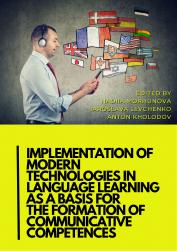
Opryshko, N., Ahibalova, T., Misenyova, V., Sadenova, A., & Myrzabekova, M. (2025). Technological means of achieving second language learners’ idiomaticity as a way to build international communication competency. In N. Morhunova, I. Levchenko, & A. Kholodov (Eds.), IMPLEMENTATION OF MODERN TECHNOLOGIES IN LANGUAGE LEARNING AS A BASIS FOR THE FORMATION OF COMMUNICATIVE COMPETENCES (pp. 89–102). Kharkiv: TECHNOLOGY CENTER PC. https://doi.org/10.15587/978-617-8360-15-3.ch6